Markup and margin both describe the profit on a sale, and they use the same two numbers: what an item cost you and what you sold it for. The difference is what you divide by. Markup compares profit to cost. Margin compares profit to the selling price. That one change is why a 50% markup is only a 33.3% margin, and why mixing them up can underprice a whole product line.
Markup vs margin at a glance
| Markup | Margin (gross margin) | |
|---|---|---|
| What it measures | How much you add on top of cost | How much of each sale you keep as gross profit |
| Formula | (Price − Cost) ÷ Cost | (Price − Cost) ÷ Price |
| Based on | Cost | Selling price (revenue) |
| Can it go over 100%? | Yes | No |
| Mostly used for | Setting prices | Reading profitability on reports |
What is markup?
Markup is the amount you add to a product’s cost to get its selling price, shown as a percentage of the cost.
Markup % = (Selling price − Cost) ÷ Cost × 100
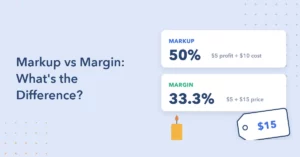
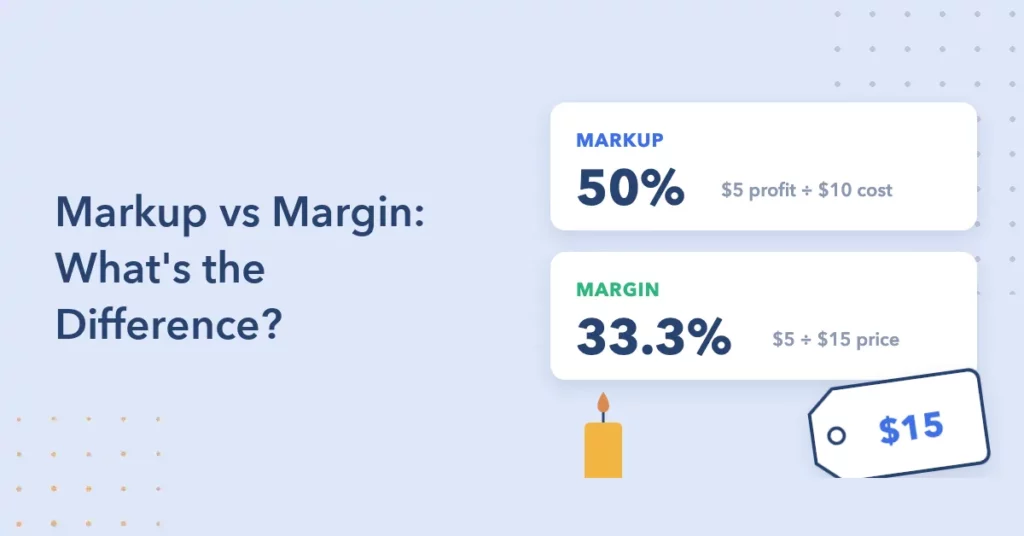
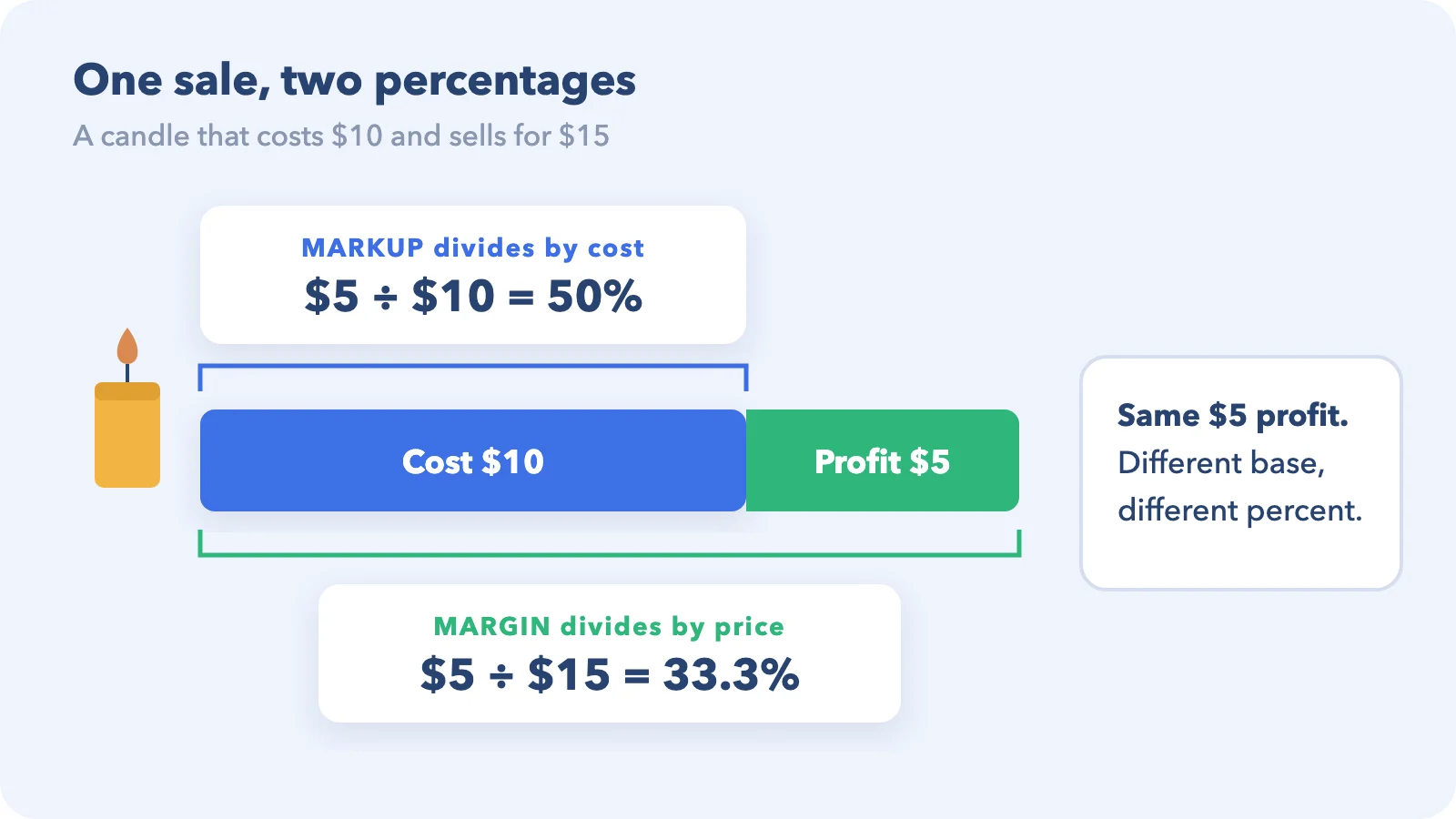
If a candle costs you $10 and you sell it for $15, the $5 you added is a 50% markup ($5 ÷ $10). To go the other way and set a price from a markup, use Price = Cost × (1 + Markup %).
What is margin?
Margin, usually called gross margin or gross profit margin, is the share of the selling price you keep after paying for the product.
Margin % = (Selling price − Cost) ÷ Selling price × 100
The same candle earns $5 on a $15 sale, so the margin is 33.3% ($5 ÷ $15). To set a price that hits a target margin, use Price = Cost ÷ (1 − Margin %). This is the number your income statement shows as gross profit divided by revenue.
Why margin is always lower than markup
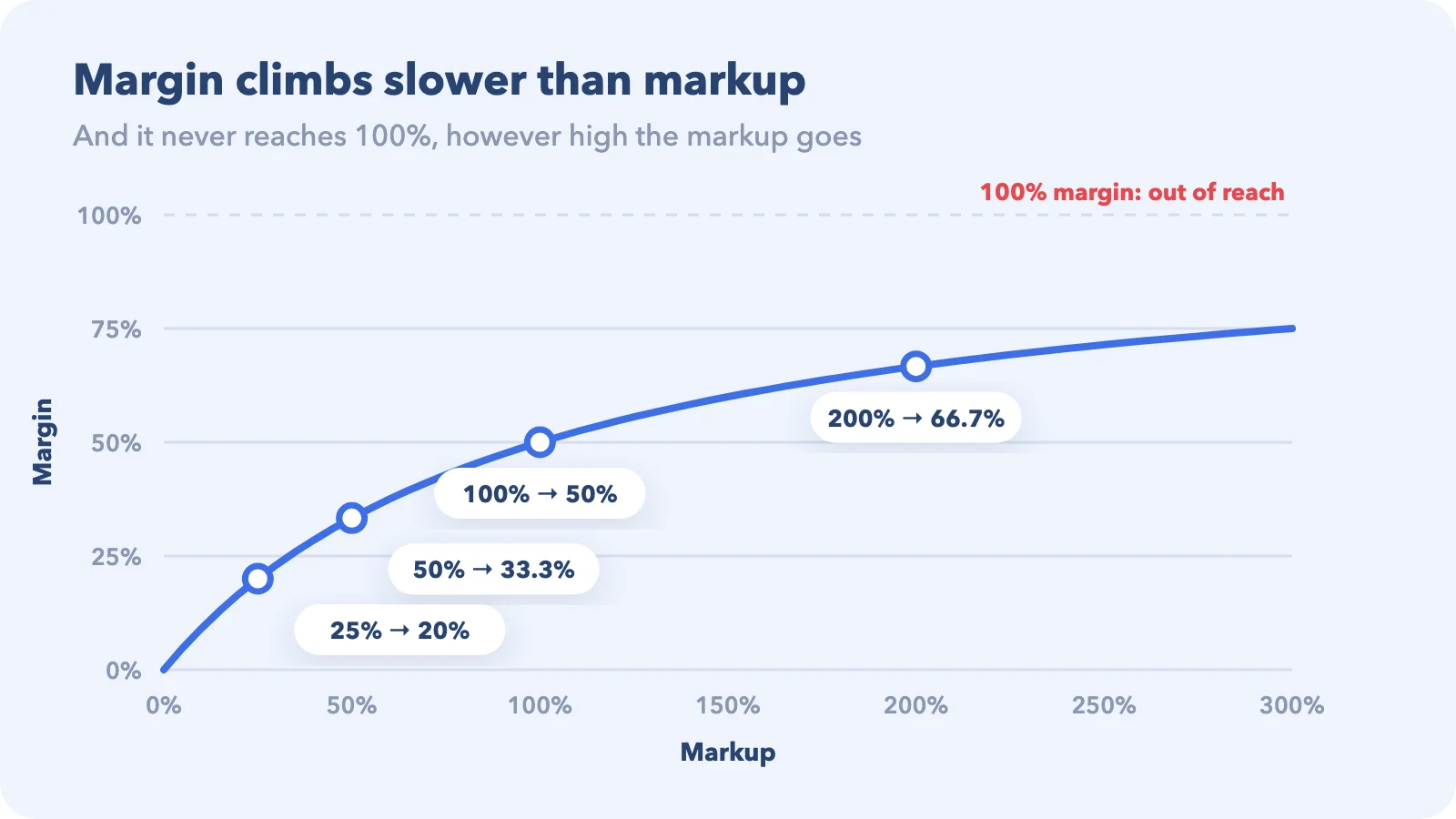
The profit is the same in both formulas, but the selling price is always bigger than the cost when you make a profit. Dividing the same profit by a bigger number gives a smaller percentage. It also means margin can never reach 100%, because that would need the product to cost nothing. Markup has no ceiling: a 300% markup is perfectly possible on low-cost items.
Keystone pricing: the 100% markup that gives a 50% margin
Keystone pricing is a common retail rule of thumb: double the wholesale cost. That’s a 100% markup and a 50% margin. A sweater that costs $20.00 sells for $40.00, and half of every sale is gross profit.
Treat keystone as a starting point. Fast-moving basics that shoppers compare across stores often sell below keystone. Slow sellers, fragile items and products that need extra handling or storage often need more than keystone to cover what they cost you to carry. If a brand sets a minimum advertised price, your room to move is narrower again; see how MAP pricing works.
How to convert markup to margin, and margin to markup
- Margin = Markup ÷ (1 + Markup). A 25% markup is 0.25 ÷ 1.25 = 20% margin.
- Markup = Margin ÷ (1 − Margin). A 40% margin needs 0.40 ÷ 0.60 = 66.7% markup.
Markup you need for a target margin
| Target margin | Markup needed |
|---|---|
| 10% | 11.1% |
| 20% | 25.0% |
| 25% | 33.3% |
| 30% | 42.9% |
| 35% | 53.8% |
| 40% | 66.7% |
| 50% | 100.0% |
| 60% | 150.0% |
Margin you get from a markup
| Markup | Margin |
|---|---|
| 20% | 16.7% |
| 25% | 20.0% |
| 50% | 33.3% |
| 75% | 42.9% |
| 100% | 50.0% |
| 150% | 60.0% |
| 200% | 66.7% |
For any other number, use the free markup calculator. It works out a price from a markup or a target margin and shows both percentages.
Retail example: the cost of confusing the two
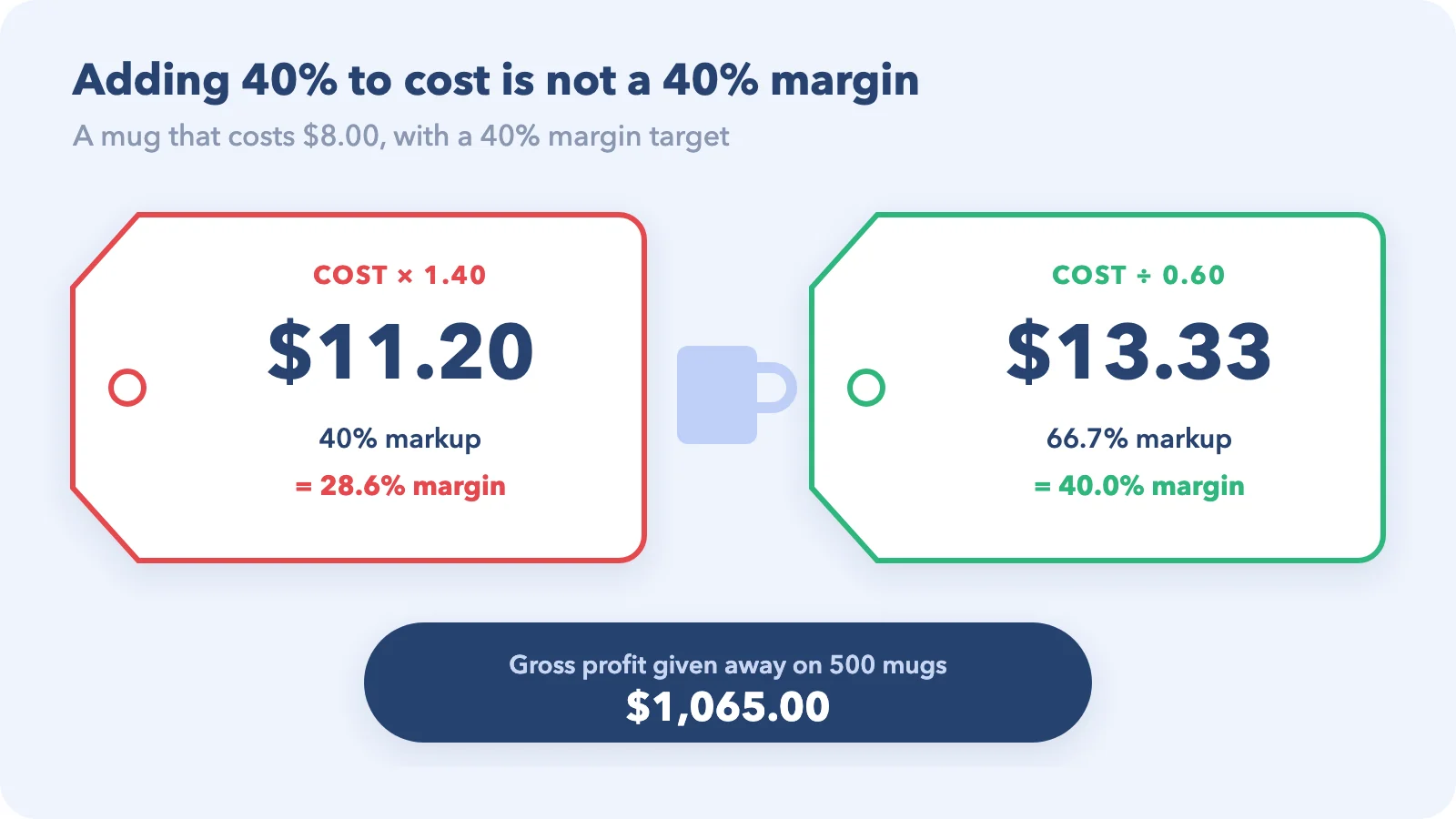
A gift shop buys mugs for $8.00 each and wants a 40% margin. The owner adds 40% to the cost instead: $8.00 × 1.40 = $11.20. That price is a 40% markup, but only a 28.6% margin.
To actually earn a 40% margin, the price has to be $8.00 ÷ (1 − 0.40) = $13.33, a 66.7% markup. Across 500 mugs, the difference is $1,065.00 of gross profit the shop gave away without noticing.
Wholesale example: margin on landed cost
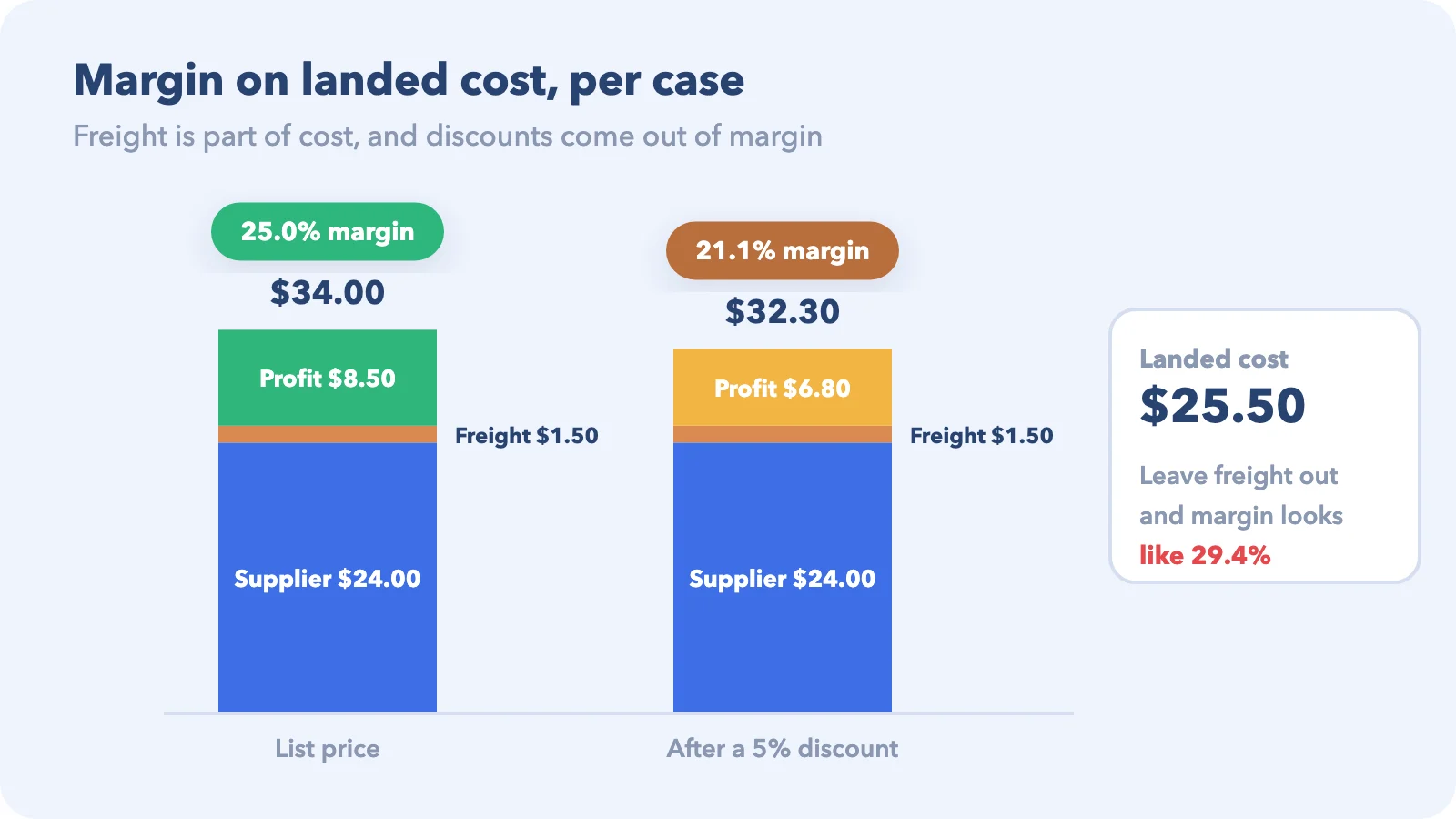
A distributor pays $24.00 a case to the supplier plus $1.50 a case in inbound freight, so the landed cost is $25.50. It sells the case to retailers for $34.00.
- On landed cost: markup is 33.3% and margin is 25.0%.
- If freight is left out of cost, the same price looks like a 41.7% markup and a 29.4% margin, so the margin looks 4.4 points better than it is.
- A 5% volume discount takes the price to $32.30 and the margin down to 21.1%.
Small changes to cost and discounts move margin quickly, which is why wholesalers check margin on every order. Learn which costs belong in unit cost in the cost of goods sold formula, and see how distributors make money at each step from supplier to shelf.
How much volume discount can you afford?
Before you quote tiered prices to a retailer, set a margin floor: the lowest margin you’ll accept on an order. Your lowest possible price is landed cost ÷ (1 − margin floor). With a 15% floor, that’s $25.50 ÷ 0.85 = $30.00 a case, so the deepest discount you can give off $34.00 is 11.8%.
| Discount | Price per case | Gross profit per case | Margin |
|---|---|---|---|
| 0% | $34.00 | $8.50 | 25.0% |
| 5% | $32.30 | $6.80 | 21.1% |
| 10% | $30.60 | $5.10 | 16.7% |
| 15% | $28.90 | $3.40 | 11.8% |
Each 5% off the price takes 20% of the gross profit per case, because the cost stays the same while the price falls. Put your floor in writing so sales reps can say yes to a big order without guessing.
Your margin is only as good as the cost behind it. Vencru keeps inventory, purchase orders, invoicing and accounting in one app. Every invoice or POS sale reduces stock and records cost of goods sold using average costing, so you can see gross profit without rebuilding a spreadsheet each month. See how it works for wholesalers and retailers, or start a 14-day trial.
How to set a price that hits your target margin
- Start from landed cost. Add inbound freight, duties and packaging to the supplier price, per unit.
- Set a target margin by category. Gift items, everyday basics and bulky goods rarely earn the same margin, so one store-wide number will overprice some and underprice others.
- Price = landed cost ÷ (1 − target margin). For the mug: $8.00 ÷ 0.60 = $13.33.
- Round to a price point, then check the margin again. $13.99 gives a 42.8% margin. $12.99 would drop it to 38.4%, below the target.
- Recheck when costs or discounts change. If the supplier raises the mug to $8.60 and the shelf price stays at $13.99, the margin falls to 38.5%.
The free markup calculator does steps 3 and 4: it finds the price for a target margin, then checks the markup and margin on the price point you choose. For a full price list, the product pricing calculator template lays out cost, markup and margin per product.
Markup or margin: which should you use?
- Use markup when you set prices. It starts from cost, which you know when stock arrives, so it’s quick to apply to a price list or a new product.
- Use margin when you check profitability. Your income statement and sales reports show margin, because it’s measured against revenue, and it’s the figure a lender or accountant reads from them.
- Agree on one term with your team. If buyers think in markup and finance thinks in margin, write targets in both, for example “40% margin (66.7% markup)”.
Common markup and margin mistakes
- Applying a margin target as a markup. As the mug example shows, this underprices every item.
- Using the supplier price instead of landed cost. Freight, duties and packaging are part of what an item costs you.
- Forgetting discounts and promotions. A price that hits your margin before a discount may not hit it after.
- Not updating cost when supplier prices change. If your selling price stays the same and cost goes up, your margin shrinks on every sale until someone rechecks the price.
- Comparing gross margin to net margin. Markup and gross margin only cover the cost of the product. Net margin also takes off rent, wages and other expenses. See contribution margin for the step in between, and profitability ratios for the wider view.
See your real margin on every sale
Markup is a pricing decision. Margin tells you whether it worked, and it’s only right when your costs are. Vencru’s inventory and accounting software ties every sale to the stock it used, so gross profit stays current as costs change. Start a 14-day trial.
More pricing help: markup calculator · product pricing calculator template · retail vs wholesale pricing · MAP pricing
Questions about markup and margin
What is the difference between markup and margin?
Markup is profit as a percentage of cost. Margin is profit as a percentage of the selling price. On an item that costs $10 and sells for $15, the markup is 50% and the margin is 33.3%.
Is a 50% markup the same as a 50% margin?
No. A 50% markup gives a 33.3% margin. To get a 50% margin you need a 100% markup, which means doubling the cost (keystone pricing).
What markup do I need for a 40% margin?
A 66.7% markup. Use markup = margin ÷ (1 − margin): 0.40 ÷ 0.60 = 0.667.
Can margin be more than 100%?
No. Margin is profit divided by the selling price, and profit can never be larger than the price. Markup can be over 100%, because it is measured against cost.
Do retailers use markup or margin?
A common approach is to set prices with markup, because it starts from cost, and then review results with gross margin, because that is what the income statement shows. Either works, as long as everyone knows which one a target refers to.
What is keystone pricing?
Keystone pricing means setting the retail price at double the wholesale cost. That is a 100% markup and a 50% gross margin.
How do I calculate a selling price from cost and margin?
Divide cost by one minus the margin. For a 40% margin on an item that costs $8.00: $8.00 ÷ 0.60 = $13.33.
Is gross margin the same as profit margin?
Not quite. Gross margin only takes off the cost of the goods sold. Net profit margin also takes off operating expenses such as rent, wages and marketing, so it is always lower.