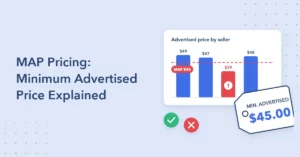
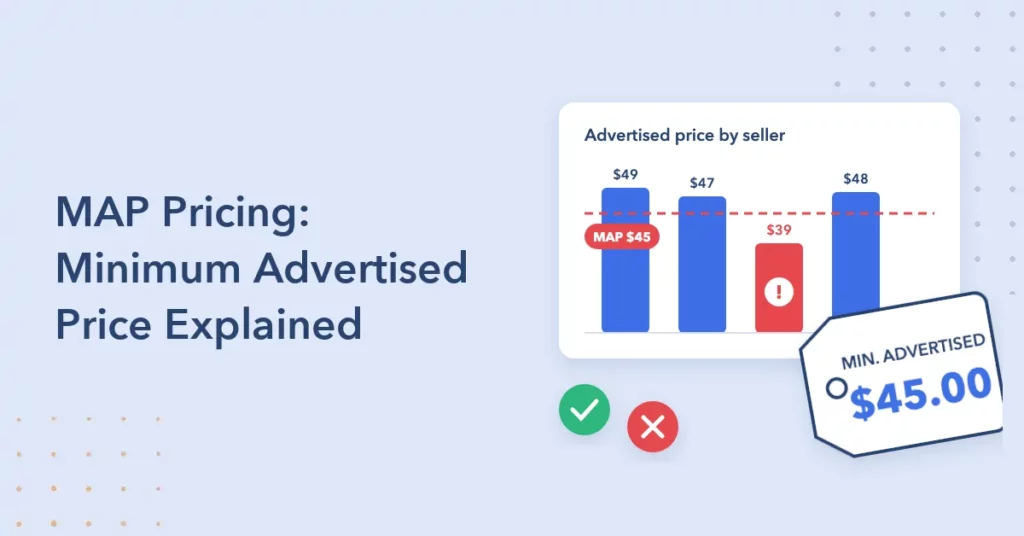
MAP pricing, short for minimum advertised price, is the lowest price a brand or supplier allows its resellers to advertise a product for. A retailer can still sell for less at the register or in the cart. It just can’t show a lower number in ads, on product pages or in emails.
Brands use MAP to stop online price wars. Retailers accept it because it protects their margin on every unit. Below: how a MAP policy works, MAP vs MSRP, the legal rules in the US and Canada, and what MAP does to margins.
This is general information, not legal advice. Talk to a competition or antitrust lawyer before you adopt or enforce a pricing policy.
What is MAP pricing?
A minimum advertised price is a floor on the advertised price, not on the selling price. The brand publishes a MAP for each product, usually in a price list or a written MAP policy, and tells authorized resellers what happens if they advertise below it.
MAP is most common for branded goods sold through many retailers and marketplaces at once, such as electronics, outdoor gear, tools and beauty. If you are building a brand, including a private label line you sell to other retailers, MAP is one of the main tools you have to keep pricing consistent across your channel.
Who sets MAP?
The manufacturer or brand owner sets it. In some supply chains a distributor passes the brand’s MAP policy down to the retailers it serves, but the policy belongs to the brand.
MAP vs MSRP vs MRP
| Term | What it means | Is it binding? |
|---|---|---|
| MAP (minimum advertised price) | Lowest price a reseller may advertise | Enforced through the brand’s policy, usually by stopping supply or co-op funds |
| MSRP (manufacturer’s suggested retail price) | The price the brand recommends for retail | A suggestion; retailers may sell above or below it |
| MRP (maximum retail price) | A ceiling on the retail price, printed on packaging in some markets outside North America | Depends on local law |
| Resale price maintenance (RPM) | A supplier controlling the actual price a reseller sells at | Legal treatment varies by country and state |
A typical setup: MSRP of $79.99 and MAP of $69.99. The retailer can advertise at $69.99 or more, and may charge less in the cart if the policy allows it.
MAP vs resale price maintenance
The difference matters legally. MAP limits what a reseller advertises. Resale price maintenance limits what a reseller charges. A MAP policy that in practice stops retailers from selling below a set price can start to look like resale price maintenance, so brands should keep the two clearly apart.
How a MAP policy works
What counts as “advertised”
The policy defines which prices are covered, usually:
- Product pages, listings and search ads
- Email and SMS campaigns
- Print ads, flyers and catalogs
- Marketplace listings such as Amazon or eBay
- Social media posts that show a price
Many policies exclude prices a shopper sees only after adding to cart or logging in. That’s where “see price in cart” messages come from.
In-cart and in-store pricing
Because MAP covers advertising, in-store prices, quotes on request and in-cart prices are often outside the policy. Each brand writes its own rules, so check rather than assume.
Enforcement
Common enforcement steps:
- Warnings, then suspension. A first violation gets a notice; repeat violations pause shipments for a set period.
- Loss of authorized status. The retailer can no longer buy from the brand or use its images and trademarks.
- Loss of co-op advertising funds. Brands that pay part of a retailer’s ad costs can withhold that money from retailers who advertise below MAP.
Unilateral policy
In the US, most brands structure MAP as a unilateral policy. The brand announces the policy and decides on its own whom it will keep supplying. It doesn’t ask retailers to sign an agreement or negotiate the price with them.
Is MAP pricing legal?
In general, yes, in both the US and Canada, but the details matter.
United States: the Colgate doctrine and Leegin
- United States v. Colgate & Co. (1919). The Court held that a manufacturer acting on its own may announce in advance the circumstances under which it will refuse to sell. This is the basis for unilateral MAP policies.
- Leegin Creative Leather Products v. PSKS (2007). The Court ended the rule that minimum resale price agreements were automatically illegal. They are now judged under the “rule of reason,” which weighs harms against benefits case by case, and can still be unlawful.
The Federal Trade Commission’s guidance on manufacturer-imposed requirements says a manufacturer has considerable freedom to set terms for advertising it helps pay for. It also describes MAP policies the FTC challenged for going too far: they blocked discounted ads even when retailers paid for them and reached in-store advertising.
State laws can differ
Leegin changed the federal standard, not every state’s. The FTC notes that some state antitrust laws still treat minimum resale price rules as illegal per se, so have counsel check state law too.
Canada: section 76 of the Competition Act
In Canada, price maintenance is covered by section 76 of the Competition Act. It is a civil provision, not a criminal one, after 2009 amendments decriminalized price maintenance. The Competition Tribunal can act when a supplier uses an agreement, threat, promise or similar means to push a reseller’s price up, or refuses to supply someone because of their low pricing, and that conduct has or is likely to have an adverse effect on competition.
The Competition Bureau’s price maintenance enforcement guidelines say the provision can cover minimum resale price, MSRP and MAP policies. A few points from those guidelines stand out for brands:
- When a supplier publishes an advertisement that mentions a resale price, that is treated as proof of upward influence unless the ad makes clear, in plain language, that the product may sell for less.
- A suggested price is treated as proof of influence unless the supplier made clear the reseller was free to ignore it without consequence.
- The Bureau is concerned only where price maintenance is likely to create, preserve or enhance market power, and generally does not look further when a firm’s market share is below 35 percent.
The Bureau is reviewing these guidelines. It published draft Anti-Competitive Conduct and Agreements guidelines in October 2025 that would replace them once finalized, so check the Bureau’s site for the current version.
How to write a MAP policy
A clear policy is easier to follow and to enforce consistently. Include these sections:
- Purpose. One or two sentences on why the policy exists, such as protecting brand value and retailer investment.
- Scope. Which products, which resellers (authorized dealers, distributors, marketplaces) and which countries.
- MAP prices. Where the current MAP list lives and how much notice you give before changes.
- Definition of “advertised.” Channels covered and those excluded, such as in-cart, in-store or quoted prices.
- Promotions and exceptions. Brand-approved sales events, clearance of discontinued items, bundles.
- Unilateral statement. That the brand sets the policy on its own and is not seeking any agreement from resellers.
- Consequences. What happens on a first, second and third violation, and for how long.
- Reinstatement. How a suspended reseller can be restored.
- Contact. Who handles questions and reports. Sales reps should not negotiate exceptions one by one.
Have a lawyer review the final version, especially if you sell in Canada or in states with stricter resale pricing rules.
How retailers comply with MAP
If you resell branded products, MAP compliance is mostly a process problem.
- Keep a current MAP list for every brand you carry. Store it next to your cost and selling price so anyone changing prices can see the floor.
- Check sale prices before campaigns go live. Storewide discounts and coupon codes are a common way to slip below MAP by accident.
- Know each brand’s in-cart rules. Some allow lower cart prices; others count any price a shopper can see without buying.
- Watch marketplace repricing tools. Automated repricers can undercut MAP within minutes.
- Keep records of brand-approved promotions. If a brand approves a holiday price, keep the email.
How brands monitor MAP
Monitoring usually combines:
- Manual spot checks of top resellers and marketplaces
- Price monitoring services that scan listings and flag violations
- Reports from authorized resellers who see others undercutting them
- Test purchases to confirm who is selling unauthorized stock
Whatever you use, document each violation with a screenshot, the URL, the date and the price, and apply the same consequences to every reseller.
Pros and cons of MAP pricing
| Effect | For brands | For retailers |
|---|---|---|
| Pros | Protects brand perception and price consistency; supports retailers who invest in service and display | Protects margin; reduces price wars with low-cost sellers |
| Cons | Monitoring and enforcement take time; inconsistent enforcement weakens the policy | Less freedom to compete on advertised price; harder to clear slow stock |
For retailers, the biggest risk is holding stock you can’t discount in ads. Watch sell-through on MAP items closely so you don’t over-order.
How MAP affects margins: a worked example
Say a brand sells a backpack to retailers at a wholesale price of $40. The MSRP is $79.99 and the MAP is $69.99. Gross margin here is gross profit divided by the selling price.
Gross margin = (Selling price − Cost) ÷ Selling price
| Scenario | Retail price | Retailer cost | Gross profit | Gross margin |
|---|---|---|---|---|
| Sold at MSRP | $79.99 | $40.00 | $39.99 | 50.0% |
| Sold at MAP | $69.99 | $40.00 | $29.99 | 42.8% |
| Lower in-cart price allowed by the policy | $62.99 | $40.00 | $22.99 | 36.5% |
| No MAP, competitor undercuts to $49.99 | $49.99 | $40.00 | $9.99 | 20.0% |
At MAP, the retailer keeps $29.99 a unit. If a competitor without any price floor drops to $49.99 and the retailer matches, profit falls to $9.99 a unit, a third of the MAP figure. That’s the margin protection MAP is designed to provide.
The brand’s own margin doesn’t change in this example. If the backpack costs the brand $20 to make, it earns $20 on each $40 wholesale sale, a 50% margin, whatever the retailer charges. What MAP protects for the brand is its channel: retailers keep carrying a product that still pays.
This math only holds if your cost is accurate. Freight, duties and discounts change the real unit cost, so track cost of goods sold rather than relying on the supplier’s list price. If you sell both to stores and to consumers, the gap between your retail and wholesale pricing also needs to leave room for your resellers’ margin at MAP.
How Vencru helps
Vencru doesn’t monitor MAP or enforce price lists. It handles the inventory, invoicing and accounting work that sits behind your pricing decisions:
- Stock and cost. Track stock levels with COGS at average cost, so your margin math uses real unit costs.
- Purchasing. Raise purchase orders, receive partial deliveries and record vendor bills (Growth plan and up).
- Wholesale invoicing. Send invoices with payment terms such as Net 30, add sales tax, and send customer statements.
- Reporting. Double-entry accounting reports, a sales tax report, and A/R and A/P aging.
- Online sales. Sync with Shopify, with Amazon and WooCommerce on the Enterprise plan.
See how it works for wholesale businesses or for ecommerce inventory. Try Vencru free for 14 days. No credit card required.
Frequently asked questions
What does MAP mean in pricing?
MAP stands for minimum advertised price. It is the lowest price a brand allows its resellers to advertise a product for. Retailers can usually charge less at checkout, depending on the brand’s policy, but they can’t show a lower price in ads or listings.
What is the difference between MAP and MSRP?
MSRP is the price a manufacturer suggests for retail sale, and retailers can sell above or below it. MAP is the lowest price a reseller may advertise under the brand’s policy. MAP is usually set below MSRP, giving retailers some room to promote.
Is MAP pricing legal?
In the US, unilateral MAP policies are generally lawful under federal law, and resale price agreements are judged under the rule of reason since the Supreme Court’s 2007 Leegin decision. Some state laws are stricter. In Canada, section 76 of the Competition Act applies when price maintenance harms competition. Get legal advice for your situation.
Can a retailer sell below MAP?
Often, yes. MAP covers advertised prices, so many policies allow lower prices in the cart, in store or on request. The brand may still stop supplying a retailer that breaks its policy, so read each brand’s rules before you discount.
What happens if you violate a MAP policy?
Consequences are set by each brand. Common ones are a warning, a temporary halt on orders, loss of co-op advertising funds, or removal from the brand’s authorized reseller list.
Do small brands need a MAP policy?
Not always. A MAP policy makes the most sense once your products are sold by several retailers or on marketplaces and discounting starts to hurt your resellers. A brand selling only direct to consumers has no one to apply it to.